Charmaine
I'd Like to Apologize to Every Teacher I Ever HadCharmaine matters because she embodies the gap between a student’s visible behavior and her unrealized capacity. Often late and disdainful, she can seem determined to resist the classroom, yet her writing, wit, poetry, and response to personal encouragement reveal someone testing whether school will treat her as more than a problem. Her trajectory makes Tony Danza’s teaching principle concrete: participation cannot be demanded into existence by discipline alone; it has to be invited through recognition, challenge, and trust.
Identity and Classroom Resistance
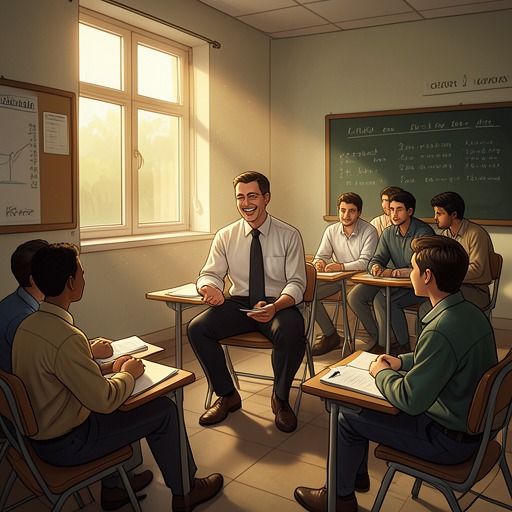
Charmaine is a tenth-grade student in Tony Danza’s English class and a constant challenge to its routines. She is frequently late, openly dismissive, and capable of withdrawing from an assignment even when she has completed part of it. Her resistance is not simple silence. It appears as attitude, performance, and verbal control: she decides how much of herself the teacher will be allowed to see and makes even compliance look like a concession.
During a writing exercise, Charmaine has produced something, but refuses to stand and read it. After repeated insistence, she rises as though the request were an unreasonable burden and presents a sentence using the required vocabulary rather than a genuine story. Her work demonstrates that she understood the assignment’s words and could manipulate them cleverly, but also that she was willing to expose the artificiality of the task instead of entering it on the teacher’s terms. Tony Danza acknowledges the cleverness while rejecting the submission as insufficient. The exchange establishes her as both oppositional and capable: she is not unable to work, but unwilling to surrender control of the work’s meaning.
Her humor also unsettles the class’s assumptions. In the school-uniform debate, Paige makes a disparaging remark about girls’ clothing, and Charmaine interrupts with a joke about her mismatched socks. The class laughs, but the moment gives Charmaine a different kind of presence. Her wardrobe, like her comments, refuses a single readable identity; it turns apparent disorder into a source of comic intelligence and allows her to redirect a morally charged argument toward the absurdity of judging people by appearance.
Detention and Self-Presentation
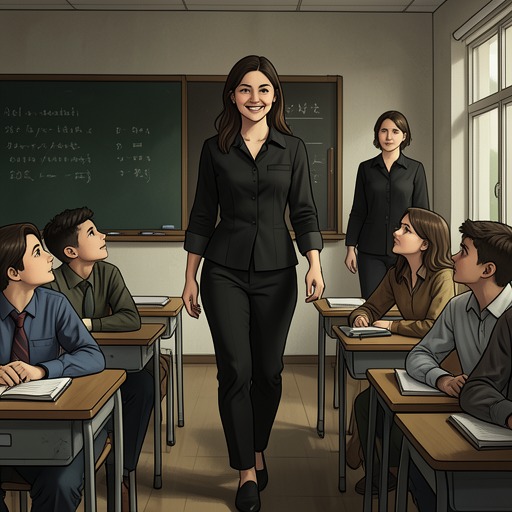
Charmaine’s disciplinary consequence is detention in Tony Danza’s classroom before school. She arrives at exactly 7:15 and sits glaring through black-rimmed glasses, a punctuality that contrasts with her usual lateness. Her appearance is assembled from contradictions: the glasses suggest the serious student she might become, while the ruffled blouse and black jumper suggest childhood; her slicked-back hair is held by pink barrettes; pins around her dress carry puns such as “I ICE CREAM” and “EYE CARE ABOUT YOU”; and her socks do not match.
These details make her clothing a form of self-presentation rather than mere decoration. Charmaine appears to hold several possible selves together at once: a child, an intellectual, a comic performer, and a student who wants to be noticed while resisting interpretation. Her choice to read Michael Jackson’s “Child of Innocence” for the poetry contest deepens that pattern. The poem’s title and the childish elements of her clothing suggest that innocence is not simply an identity she possesses, but a vulnerable register she approaches through irony and display.
When Tony Danza asks how long she expects to remain in school, Charmaine answers with sullen emphasis, “Forever!” The response sounds defiant, but it also suggests a trapped relationship to schooling. Her future is not presented as an open field; it is imagined as endless continuation. The line gives her resistance a temporal dimension: the student who refuses ordinary classroom participation may also be struggling to imagine an exit, a destination, or a reason to change.
Recognition and Turning Point
The detention becomes a private conference rather than a simple punishment. Tony Danza presses Charmaine to consider why she chose her poem and why its central line matters to her. He argues that she should allow herself the possibility of changing the world, and that she might become the person capable of doing so if she gives herself a chance. His appeal does not erase the earlier conflict or excuse her lateness; instead, it treats her defiance as evidence of a mind worth addressing.
The decisive gesture comes when the first bell rings. As Charmaine gathers her backpack, Tony Danza points to the pin reading “EYE CARE ABOUT YOU” and tells her, “I really do care about you, you know.” Charmaine smiles and replies, “Yes, Mr. Danza.” The exchange is small, but it changes the terms of their relationship. Her own joke about caring is returned to her as a sincere statement, transforming a decorative pun into an acknowledgment of attachment and responsibility.
That response is significant because Charmaine does not answer with another joke or argument. She accepts the teacher’s concern, addressing him formally while allowing the moment to remain emotionally direct. The scene does not claim that one conversation solves her difficulties. It shows instead how recognition can interrupt a defensive performance: the student who has controlled the classroom through refusal briefly permits herself to be met by another person.
Change and Narrative Significance
Over the next several days, the atmosphere of the class shifts. Students, including Charmaine, arrive more or less on time, find their seats, remain there, and participate. When Ben-Kyle notices that everyone is present, the class applauds itself. The improvement is explicitly fragile; Tony Danza doubts that it can last. Charmaine’s change is therefore not presented as a permanent conversion or a sentimental triumph. It is a visible instance of altered conduct within a collective mood that may quickly reverse.
Her role in this shift lies in the contrast between the student who once had to be coaxed to read a deliberately inadequate story and the student who now takes part in a more settled classroom. The narrative retains both versions. Charmaine remains a person of contradiction rather than becoming a model pupil: her intelligence is expressed through resistance, her vulnerability through theatrical details, and her potential through a moment of accepted trust.
Charmaine consequently supports the book’s wider argument about education as social justice and about the limits of labels such as “problem student.” The school can record lateness, assign detention, and demand participation, but those mechanisms do not explain what a student is capable of becoming. Charmaine’s mismatched socks, sharp joke, improvised pseudo-story, exact detention arrival, and quiet smile form a more complex record. Her significance is not that she is effortlessly rescued, but that sustained attention briefly makes another version of school—and of herself—possible.